

THE BUKELE TRAP
How security became the perfect shield for one of the most sophisticated forms of wealth extraction ever seen in Latin America

In June 2026, during a closed-door meeting in the Oval Office of the White House, U.S. President Donald Trump received Nayib Bukele for the second time. The details were not made public. The White House merely confirmed that it was a “private meeting” on migration and security.
Three days later, Salvadoran Vice President Félix Ulloa announced that Bukele would run again in the February 2027 elections.
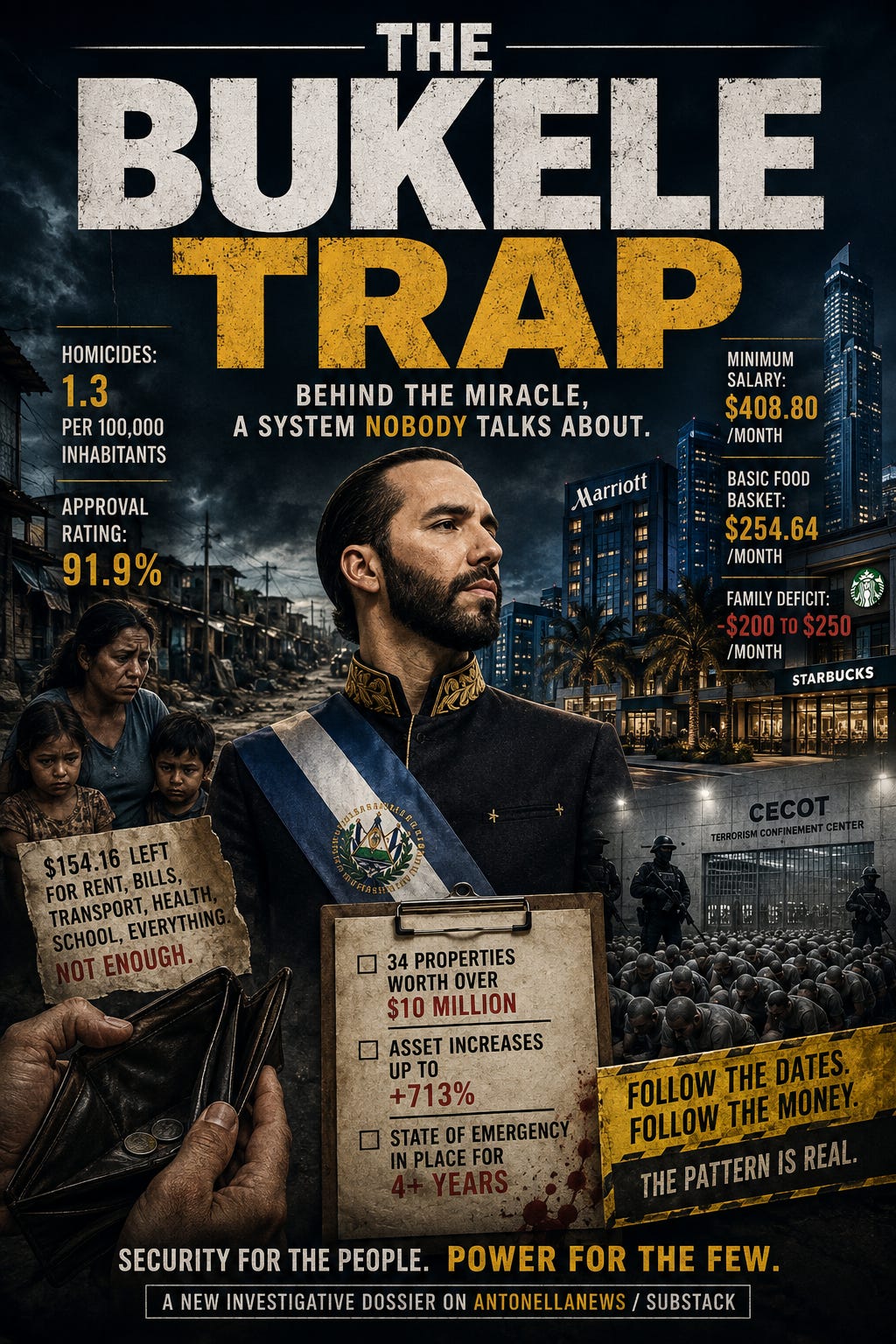
Meanwhile, data from the Banco Central de Reserva show a reality diverging from the official narrative: the minimum wage is $408.80 per month (unchanged since June 2025), while the basic food basket has risen to $254.64 per month. The monthly shortfall for a family of four is at least $200–250.
Some 91.9% of El Salvador still approves of Bukele. But that figure is beginning to lie. Because beneath the manufactured consensus lies a truth that no one in the government media wants to tell: the security Bukele promised has not made the country safer for poor people.
It has made it much richer for the elite.
And the difference between those two facts has never been documented clearly enough.
Until today.
THE SECURITY THAT WAS REAL
The story begins where all the best crime stories begin: with a real, tangible crisis.
In 2015, El Salvador recorded 100 homicides per 100,000 inhabitants. This is not an abstract statistic. It was the daily reality of a population that could not leave home at night. A shopkeeper paid $500 a month in extortion money to gangs to keep the business open. A girl could not go to school if doing so meant crossing territory controlled by Mara Salvatrucha.
Bukele arrived in 2019 with a simple promise: a hard line. By 2025, the homicide rate had fallen to 1.3 per 100,000 inhabitants. This is not propaganda. It is verifiable. It really happened.
In March 2022, Bukele imposed the régimen de excepción — the state of exception — a measure that, under the original decree, was supposed to last 30 days. Constitutional guarantees were suspended. The right to a lawyer was removed during the first 15 days of custody. Telecommunications privacy was abolished.
People applauded.
Because security arrived. It was real. It was not a future promise — it was present, tangible, verifiable in the reduction of bodies in the streets and in the silence of nighttime gunfire.
This was the genuine consensus Bukele had built. Not fake, not imposed — consensus based on a real victory against a real enemy.
But the state of exception never ended.
In June 2026, the Legislative Assembly approved the 52nd extension of the state of exception. More than four years after its “temporary” introduction, the extraordinary measure had become structural.
At the exact moment when security ceased to be a response to an emergency and became a permanent system, Bukele had already consolidated enough power to do whatever he wanted.
People did not notice because security was still real. And when there is security, people do not look elsewhere.
THE CONTROLLED NARRATIVE
Bukele does not censor the media in the traditional sense. He does not need to. He controls what is told through a combination of channels operating simultaneously.
Government media report only victories: “92,300 terrorists captured.” “1,111 consecutive days without homicides.” “The historic center redeveloped.” Photos of Starbucks and Marriott where chaos once stood. Repeated, echoed, amplified.
Bukele publicly attacks journalists on X, accusing them of being “paid by Soros” to spread lies about his administration. This is not direct censorship. It is the delegitimization of the source itself.
Evangelical churches, representing 60% of the Salvadoran population, have embraced Bukele as a messianic figure. The theological rhetoric is literal: “God chose Bukele to cleanse our country of evil.” When religion and politics merge, rational criticism becomes heresy.
The political opposition is absent as a credible force. The FMLN party (left) has been corroded by the corruption of previous governments. The traditional right has been absorbed. There is no political center. The next elections in February 2027 will see Bukele as the official candidate of his Nuevas Ideas party with no visible challengers.
Twitter is the direct channel. Bukele does not speak to the media — he speaks to his 16 million followers. No filters, no uncomfortable questions. Only short messages built for virality, dividing the country between “those who understand” and “enemies of the homeland.”
The result is 91.9% approval. Not manufactured by corrupt pollsters — rooted in genuine relief from gang violence combined with a totally controlled narrative.
But the Trojan horse of security carried something much larger inside the walls: Bukele’s right to do whatever he wanted, as long as security remained.
THE CONSOLIDATION OF POWER IN 15 MONTHS
The constitutional reform of July 31, 2025 was not improvisation.
That morning, El Salvador’s Legislative Assembly voted in a single day on a reform that should have required months of debate. 57 votes in favor, 3 against. No documented debate. No prior analysis.
The reform did four things:
It allowed reelección indefinida — indefinite re-election — abolishing the two-consecutive-term limit that the original Constitution explicitly prohibited.
It extended the presidential term from five to six years — more time in power in each cycle.
It eliminated the runoff — the candidate with the most votes wins everything, even with 35%.
It changed the constitutional amendment process itself.
But the timeline reveals a structure: on April 29, 2024, the outgoing legislature amended Article 248 of the Constitution to allow a single legislature to amend the Constitution. On January 29, 2025, the new legislature ratified the amendment. On July 31, 2025, that same legislature approved indefinite re-election in a single day.
Fifteen months of precise coordination to consolidate power so that when consensus inevitably collapsed, the system would remain intact.
At the moment this reform passed, Bukele knew two things. First: consensus was about to crack. In January 2026, for the first time since 2019, Salvadorans would identify the economy — not security — as the country’s main problem. Second: he needed to make power immovable before that happened.
He chose to do it not through brute force, but by legally changing the rules.
This is the genius of consensual dictatorship: it uses democratic institutions to abolish democracy, and no one notices because people vote for the candidate, not for the system.
THE UNITED STATES: PROGRAMMED DEPENDENCY
In March and April 2025, Trump began deporting migrants directly to El Salvador, bypassing asylum processes. In the first half of 2025, more than 273,000 people were arrested by ICE, and about 239,000 were deported.
But the number matters less than the strategy.
If Trump deports someone within the United States and that person sues the U.S. government for rights violations, there is a legal remedy. If Trump deports that person to El Salvador, and Bukele tortures them in CECOT, the legal remedy disappears. They are not an American problem — they are a Salvadoran problem.
Forty-four percent of El Salvador’s GDP comes from family remittances. Who controls remittance flows? U.S. migration policy. If Trump decides to stop work visas for Salvadorans, El Salvador’s economy collapses. Not in years — in months.
Bukele knows this. That is why he cannot say no to Trump. That is why he accepts migrants into his CECOT and tortures them. Not because Bukele is different from other dictators — but because he knows his survival depends on Trump.
In February 2025, Trump receives Bukele at the White House and publicly supports the deportation of migrant Kilmar Ábrego García, despite a judicial order barring his removal. In July 2026, Trump receives Bukele again behind closed doors.
This is not an alliance between equals. It is a vassal with an email address.
ISRAEL: THE AMBASSADOR INSIDE THE INNER CIRCLE
In 2024, one figure moved through Bukele’s inner circle: Shimon Axel Wahnish, described as Bukele’s “personal rabbi.” In 2024, Wahnish became Israel’s Ambassador to El Salvador.
This is not a minor administrative position. It means that a representative of the Israeli government has direct access to the Salvadoran president. He has influence over decisions. He has representation.
Karim Bukele and Yusef Bukele, the president’s brothers, bought properties in San Salvador’s Historic Center through the company Lagencia. Two of these properties fall within the Historic Center tax-exemption zone — exactly the area where the Bukele-controlled Legislative Assembly approved exemptions.
Who benefits from the redevelopment of the Historic Center? Foreign investors. Among them, Israeli capital.
In Latin America, there is a term for these unofficial arrangements: “Acuerdos de Isaac.” Agreements between right-wing governments, Israeli allies, and the American strategy of controlling the region through dictators who answer to commands.
The pattern is traceable. Argentina/Milei has publicly embraced Netanyahu and receives Israeli investment. El Salvador/Bukele has an Israeli ambassador inside the inner circle and receives Israeli investment. Colombia is in the gray zone, but the alignment remains.
These countries do not choose this alignment autonomously. It is offered to them as part of a package: “Consolidate your power, remain loyal, and we will send investment, diplomatic support, and military assistance.”
For Bukele, it means: Trump publicly supports his junta. Israel sends him capital and ideological influence. He remains in power indefinitely. His families grow richer.
But the price is that El Salvador remains economically dependent on the outside world and politically a vassal of forces that do not answer to Salvadorans.
THE VERIFIABLE ENRICHMENT
Bukele and his family have acquired 34 properties valued at more than $10 million. The family includes his wife Gabriela Rodríguez, his mother Olga Ortez, and his brothers Karim, Ibrajim, and Yusef Bukele.
2019–2024: 16 properties for $1.4 million
2024–2025: 18 properties for $8+ million
The pace of enrichment accelerates precisely as he consolidates power. The investigation examined 64 deeds, 10 mortgages, and the profiles of 40 Bukele family companies registered through March 2024.
These are not hidden numbers. They are public records. But no one in El Salvador notices because government media do not report them.
THE HISTORIC CENTER CASE
Before Bukele, San Salvador’s Historic Center was an informal market. Tens of thousands of street vendors sold everything. In 2023, Bukele announces the “redevelopment.” Officially, it is urban rebirth. In reality, it is extraction.
About 20,000 families who earned their daily income in the Historic Center were expelled. Vendors report: “If they see us selling, they take our goods away. We cannot complain because they take us to prison.”
The moment the poor are expelled, investors arrive. Starbucks, Marriott, KFC. Prices no ordinary Salvadoran can afford.
But before the investors arrive, someone buys the land.
Karim Bukele bought a building in the Historic Center for $1.3 million. This acquisition took place three months after the Legislative Assembly passed a law exempting investors in the Historic Center from taxes.
Who voted for the tax exemption? The Legislative Assembly, controlled by Bukele.
The cycle is perfect: Government passes law → Family buys property → Property appreciates → Government invites foreign investors → Investors build → Prices rise → Family is left holding properties now worth tens of millions.
THE TWENTY-ONE OFFICIALS WHO GREW RICHER
An El País analysis of 75 asset declarations concluded that at least 21 officials increased their wealth by as much as 713% during the Bukele administration.
Ernesto Sanabria (Press Secretary): assets from $270,000 to $2 million.
Carolina Recinos (Chief of Staff): massive increase.
Miguel Kattán (Secretary of Commerce and Investment): gross assets of $3.9 million.
Douglas Rodríguez (President of the Central Bank): documented increase.
These are not crimes within Bukele’s system — they are legal because the laws were changed to allow them. The implicit message is crystal clear: “Serve the president, get rich. Criticize the president, disappear.”
The result is a new oligarchy — no different from the old one, only younger and better coordinated. Bukele promised to “destroy the old oligarchy.” He simply seated a new elite at the table and allowed it to grow rich as long as it remained loyal.
THE INVISIBLE ECONOMIC COLLAPSE
In 2019, the cost of the canasta básica — the minimum food basket for a family of four — was $200 per month. In March 2026, it was $254.64 in urban areas — an increase of 27.3% in seven years.
But the real blow is this: the minimum wage in commerce and services is $408.80 per month, unchanged since June 2025. No increase for 14 months while the basic food basket continues to rise.
Do the math for a Salvadoran family:
Minimum wage: $408.80
Basic food basket (food only): $254.64
Left for everything else: $154.16
Rent for one room: $50–80
Electricity and water: $20–30
Transport: $10–15
School: $5–10
Medicine: $5–20
Clothes: impossible
The shortfall is at least $200–250 per month.
How do they survive? Debt at annual interest rates of 30–40%. Informal, off-the-books work. Remittances from relatives in the United States. Deprivation — skipping meals, children going to school without breakfast.
A recent investigation by the Instituto Universitario de Opinión Pública (IUDOP) in January 2026 shows that 28.4% of the population identifies the economy as the country’s main problem. For the second consecutive year, economic problems outrank security.
This is the crack in the 91.9% consensus. In 2025, for the first time since 2019, people identified the economy — not security — as the main problem. In 2026, that continues.
It means that 91.9% is standing on quicksand. The 40–50% who vote for security remain firm. But the 30–40% who vote because there is no alternative are beginning to notice that the alternative — starving — is becoming reality.
Bukele knows this. That is why he constitutionally consolidated power before the collapse became visible.
THE 33,000 INNOCENT PEOPLE INSIDE THE SYSTEM
Bukele’s state of exception is not simply a security instrument. It is a system of legal terror.
The World Organisation Against Torture has classified El Salvador as a country at high risk of torture and ill-treatment, with documented practices of systematic beatings, sexual humiliation, sleep deprivation, and collective punishment.
Reports indicate that thousands of people — estimated at more than 33,000 out of roughly 92,000 arrests — may never have had established links to gangs.
One third of all those arrested under the state of exception are innocent people.
THE 252 VENEZUELANS TORTURED
In March and April 2025, the Trump administration deported 252 Venezuelan citizens directly to El Salvador. They had not been tried in the United States. They had been accused of “gang affiliations” by anonymous accusers. The U.S. government used the Alien Enemies Act of 1798 — a wartime law — to deport them without due process.
Bukele put them in CECOT.
Gonzalo Y., 26, from Zulia, recounted that a guard ordered him to kneel with his head down. He said he had a spinal problem. The guard struck him in the neck with a baton.
Maiker Espinoza Escalona described CECOT as “unfit to hold human beings,” reporting a foul smell of feces that made detainees sick, while they endured “torture in a sudden and inhumane way.”
All 252 Venezuelans were repatriated in July, where many publicly reported having been victims of torture and cruel, inhuman, and degrading treatment. Upon their arrival in Venezuela, three Salvadorans who had also been repatriated were still reported “missing,” with authorities providing no information about their fate.
In November 2025, more than 40 U.S. senators and representatives sent a letter to Marco Rubio and Kristi Noem expressing deep concern about the systematic pattern of abuse and torture at CECOT.
In July 2026, Trump receives Bukele again. The message is clear: keep going.
THE MODEL THAT REPLICATES ITSELF
The most fascinating thing about Bukele is not that he is powerful. It is that he has become a model.
Political figures such as Daniel Noboa in Ecuador and Abelardo de la Espriella in Colombia openly look to elements of the Bukele formula, although they operate in profoundly different political, institutional, and social contexts.
Because Bukele has solved the problem that afflicts every dictator: how to establish a dictatorship without the consequences of a classical dictatorship.
Classical dictatorships fall because they are visibly brutal. People see the disappearances. They see the bodies. They see the blood.
Bukele has invented a dictatorship where:
Security is real (the gangs really have been dismantled).
Enrichment is legal (the laws have been changed to allow it).
Repression is legitimate (the state of exception is voted through by the Assembly).
The alternative does not exist (the opposition is absent).
The international alliance is stable (USA + Israel support it).
Economic dependency is programmed (remittances, deportations, foreign investment).
It is perfect. And it works so well that the “Bukele model” has now crossed El Salvador’s borders: it has become an exportable political product, invoked, imitated, or promoted elsewhere in Latin America.
And the phenomenon does not seem to stop there. In the West too, especially in Europe, some political forces and governments have begun to look with growing interest at the Bukele promise of trading part of individual guarantees for security, order, and control.
But let us stop here.
Because establishing whether the “Bukele model” was truly born in El Salvador — or whether El Salvador has become the most visible laboratory for political, security, and geopolitical dynamics developed elsewhere — requires a separate investigation.
And that story deserves to be told from the beginning.
FEBRUARY 2027: WHEN CONSENSUS BECOMES IRRELEVANT
It is August 2026. In February 2027, Bukele will win again. Probably with 70–75% approval.
But his genuine consensus will not remain at 91.9%. It will fall to 70%, then 60%.
By 2030, it could have fallen to 45%.
But by then, it will not matter. He has indefinite re-election. He has changed the runoff system. He has the Legislative Assembly. He has the security forces. He has Trump supporting him.
When consensus collapses, the dictatorship remains.
This is the true genius of “consensual dictatorship”: consensus is a means, not an end. The end is permanent power. And once it has been obtained, consensus becomes irrelevant.
THE PERFECT MACHINE
Bukele Inc. is not a traditional dictatorship. It is an authoritarian corporation — a company that runs a state as though it were a private enterprise.
The shareholders are:
The Bukele family (which grows richer)
The security apparatus (which gains power and resources)
The evangelical churches (which gain influence)
The United States (which gains geopolitical control)
Israel (which gains soft power and investment)
The customers are the population.
The product is security (real, at least) + political stasis.
The profit comes from economic extraction — from the concentration of wealth upward while the population sinks into poverty.
As with any company that works well, the system is sustainable. Not because people are happy — it is sustainable because there are no alternatives.
The question is not whether Bukele will fall. The question is: how many generations of Salvadorans will have to starve, how many human rights will have to be violated, how many political alternatives will have to be destroyed, before consensus turns into revolt?
And the answer, according to the data, is: many.
Because Bukele has not merely built a dictatorship. He has built a dictatorship that people voluntarily choose — as long as that choice means the difference between security and chaos. The moment people realize that the choice is between tyranny and hunger, consensus will collapse.
But that moment will be too late. Bukele will already have consolidated power so thoroughly that the collapse of consensus will make no difference.
THE INVESTIGATION DOES NOT END HERE
This dossier does not claim to have the final word on El Salvador. It claims something more useful: to put facts, documents, and temporal coincidences on the table that deserve to be verified, challenged, and investigated further.
Because the question left open by the Bukele case is not only about Bukele.
It is about us.
How much freedom are we willing to hand over to a government when, in return, that government promises us security? And above all: who controls what happens after that freedom has been surrendered?
If you live in El Salvador, know this reality directly, or possess documents, data, or testimony that can confirm, correct, or contradict what has been reconstructed in this investigation, write in the comments. Documented corrections do not weaken an investigation: they make it harder to demolish.
And if this investigation has shown you something that you believe deserves to be discussed, share it. Not because you have to agree with my conclusions, but so that others can examine the facts and reach their own.
AntonellaNEWS will continue to follow El Salvador, its relationship with Washington, the evolution of the state of exception, and above all what happens when security, the economy, and political consensus begin moving in different directions.
If you want to follow this and future investigations, subscribe to AntonellaNEWS on Substack and follow the video dossiers on YouTube. If you believe this work has value, you can also support it simply by sharing it: taking an investigation beyond its algorithmic bubble is already a concrete way of supporting independent journalism.
The investigation continues. And, as always, documents come before conclusions.
MAIN SOURCES
• Banco Central de Reserva de El Salvador (BCR) — economic data, remittances, inflation, and the basic food basket.
• Instituto Universitario de Opinión Pública – UCA (IUDOP) — Salvadoran public-opinion polling, presidential approval, and perceptions of the country’s main economic and social problems.
• Asamblea Legislativa de El Salvador — decrees on the régimen de excepción, constitutional reforms, and changes concerning presidential re-election.
• Registro Nacional / Centro Nacional de Registros de El Salvador — property and corporate documentation used in investigations into acquisitions by the Bukele family.
• Redacción Regional / FOCOS — documentary investigations into properties, companies, and the growth of the Bukele family’s assets.
• El País América — investigations into asset declarations of Bukele administration officials, property acquisitions, the Historic Center, and documentation concerning more than 33,000 detainees not previously registered as gang members.
• Amnesty International — “Security without rights: Impact of mass arbitrary arrests and denial of due process on the potential commission of crimes against humanity in El Salvador,” July 2026; documentation on arbitrary detention, torture, disappearances, deaths in custody, and the progressive erosion of institutional guarantees.
• Human Rights Watch / Cristosal — “You Have Arrived in Hell: Torture and Other Abuses Against Venezuelans in El Salvador’s Mega Prison,” November 2025; investigation into the 252 Venezuelans transferred from the United States to CECOT and testimony concerning torture and ill-treatment.
• U.S. Government / Congressional records and official communications — documentation concerning deportations to El Salvador, the Alien Enemies Act, CECOT, and relations between the Trump and Bukele administrations.
• Casa Presidencial de El Salvador / Presidencia de la República — official government data and statements concerning homicides, arrests, public security, and the state of exception, used as primary-source material and cross-checked against independent sources.
simple far right nazifascist Capitalism dictature, and everybody knows whom control capitalism USUK. Even to Hitler peoples laid on his hands the power.